Can the clothes and socks we wear every day really cause cancer?
- Franz Tang
- Dec 4, 2025
- 3 min read

Yes — and you’re right to be concerned.
When we think of carcinogens, we normally think of tobacco, junk food, additives, and other things we ingest.
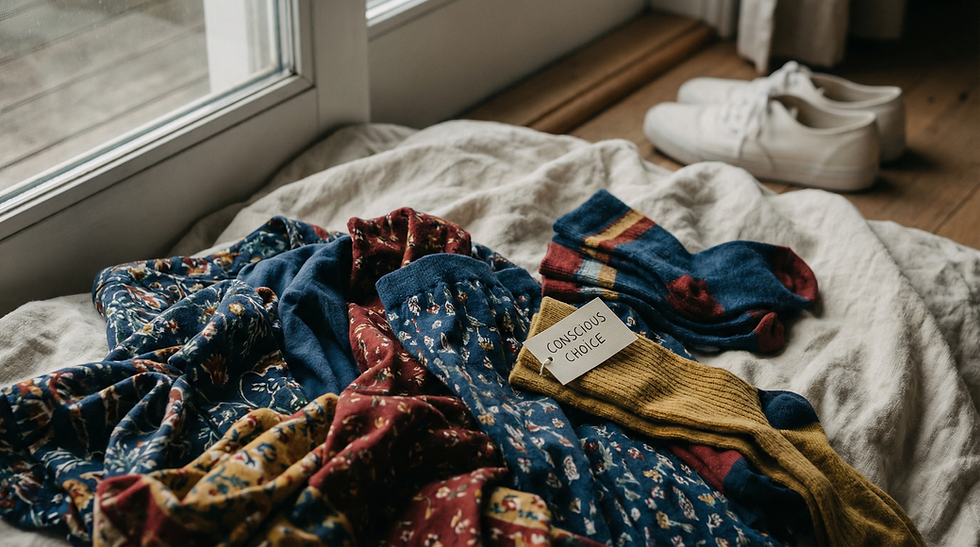
But we often overlook the fact that the garments that touch our skin every day may also carry cancer risks — and may even alter our DNA.
**01
A nationally recognized Group 1 carcinogen
is hidden inside your clothing**
Back in 2005, “carcinogenic clothing” became a hot topic.
At that time, the National Textile and Apparel Product Quality Supervision and Testing Center tested 1,051 samples submitted by 20 well-known companies in the Pearl River Delta region.
The results showed that some samples contained benzidine, a Group 1 carcinogen, far exceeding safety limits — the worst case was 190 times higher than the standard!
In 2019, when authorities conducted random inspections on dresses, luxury garments, and silk clothing on the market, a woman’s skirt was also found to contain carcinogenic aromatic amine dyes.
Benzidine in dyes is not the dye itself;
it is usually used as a raw material, along with other aromatic ring structures, as part of the chromophore system.
When clothing containing these substances stays in long-term contact with skin, harmful components can be absorbed through the skin and break down under certain conditions into over 20 carcinogenic aromatic amines, forming compounds that alter the structure and function of human DNA.
Over time, mild cases may experience headaches, nausea, and insomnia.
Severe cases may develop malignant diseases such as bladder cancer, ureter cancer, and liver cancer, with incubation periods as long as 20 years.
And it’s not just your clothes —
your socks may also contain excessive levels of carcinogens. Truly frightening.
Because these dyes are cheap and have strong coloring power, some unethical manufacturers still use them.
Life is already hard enough, yet we still face these invisible harms.
Buying a piece of clothing shouldn’t require worrying about whether it’s “toxic.”
**02
Clothing isn’t only about benzidine —
formaldehyde is also harming us**
In addition to benzidine, media reports have also revealed clothes testing positive for excessive formaldehyde.
According to national regulations, clothing labels must indicate formaldehyde levels, but many garments on the market don’t provide this information, leaving consumers in the dark.
During manufacturing and transportation, many garments are treated with chemical additives, especially formaldehyde, which prevents wrinkles and preserves color.
This means that most new clothes contain some level of formaldehyde residue.
Short-term exposure has two main effects:
Respiratory and skin irritation
Symptoms include tearing, dry cough, throat irritation, and nausea.
Skin allergies
If you feel itchy wearing new clothes, it may be a rash caused by formaldehyde.
Long-term accumulation of formaldehyde can severely damage liver and kidney metabolic functions and may induce cancers such as nasopharyngeal cancer, lymphoma, brain tumors, and leukemia.
With the convenience brought by the internet, unethical manufacturers have also gained convenience.
All we can do is remind each other of three important points.
**03
When buying clothes,
keep these things in mind**
1. Do not buy overly bright or strongly scented clothes
Overly bright colors, uneven dyeing, visible color differences, or dye transfer often indicate a higher likelihood of carcinogenic aromatic amines.
Especially for underwear — avoid flashy reds and purples.
New clothes often have mild scent, but if the smell is strong, pungent, or chemical-like, it likely contains high levels of formaldehyde.
Because most new clothes contain formaldehyde residues, washing + airing is essential.
2. Avoid extremely cheap items and ‘clearance liquidation’ clothes
These garments may come from garbage collection sites, recycling facilities, or even mortuaries.
They are neither inspected nor disinfected — terrifying to imagine, let alone wear.
Others may come from illegal workshops where every step uses the cheapest materials.
Buying them is basically paying for trouble.
After buying new clothes, soak them in warm water — especially underwear.
Formaldehyde volatilizes more easily at around 40°C.


Comments